Thursday, September 24, 2009

Superman: Secret Origin #1


The artist takes a pencil and traces an oval where the face will be. Rather than touching the pencil to the paper and drawing it in one solid curve, the oval is composed of many shorter arcs, parallel, intersecting, concentric. Each one nudges the outline from where the previous faint lines had begun, adjusting them, repositioning the curve, correcting it. The pencil is flipped and the eraser rubs some graphite off the page; a sleeve wipes the rubber and dust away, and then the pencil goes back to work. At some point, a mannequin-like shape is there, and then a face is drawn inside, outside, and over it, without ever erasing the original imperfect outline. Eventually it will have life. Eventually it will be a face. Little strokes keep touching it up, making it better, or at least different. 


Superman is a work in progress. I first realized this when I was nine and he was forty, when the movie portrayed details differently than the comics I'd been reading. Jor-El had white hair instead of black. He wore a shining robe instead of a green shirt. And many other details, important to me, had been changed. The unescapable conclusion was that the movie must be flawed; I preferred the familiar to the new.


Around that time, my teacher asked me if I could bring a comic book to school. They wanted to have one of the art teachers make a poster featuring Superman and needed an example for her to draw him from. I proudly brought in one of my late-Seventies comics, with its two dozen pages of Superman drawn by Curt Swan, countless panels for the art teacher to choose from as the basis for her poster. When I saw the final product, three feet tall hanging inside the main doors of the school, I was aghast -- she had chosen the best drawing in the comic for her purposes, but it was the wrong Superman -- the Earth Two Superman, who was posed heroically in an ad for DC Comics, unrelated to the story. Something about his face was wrong, but -- more appalling for me -- his chest symbol was flat at the bottom instead of coming to a point. I felt like a traitor to the cause of artistic truth; given a chance to personally select the vision of Superman that my whole school would see, I had introduced the "wrong Superman". It distinctly upset me, in a way I couldn't explain to anyone.


A decade later, I was in college. I hadn't read many comics over the previous six years, and had totally missed the changes wrought by The Man of Steel. When I picked up Time Magazine's 1988 article on Superman turning fifty years old, and read that Luthor had been turned into a businessman who had dated Lois. I felt about this Lex Luthor probably like Pope Leo X had felt about Martin Luther. The article didn't explain that there had been a "reboot", so I imagined that somehow old Silver Age Lex had figured out a way to woo devoted, Silver Age, Kurt Schaffenberger Lois away from Superman, and I didn't much like the thought of it. It seemed to be not merely an artist decision in one serial but a sign that somehow the whole world had gone sick and wrong.


If the editors had known how sour my reaction was, they would have winked at the camera, Clark Kent style, when they saw me, a few days later, buying a Superman comic at the college bookstore. This was a turn of events that surely would not have taken place if the Time article had led me to believe that everything in Superman's world was just as it had been when I'd stopped buying comic books. And when I picked up that issue to see that Brainiac had also been radically transformed from the android I'd known him to be, I didn't like it, but I was interested. This sent me down the path that led to buying large numbers of back issues, eventually owning the entire sequence from Man of Steel to the then-current day. It would have been foolish not to be self-aware enough to recognize that my reborn interest in the Superman series was a product of the new directions they had taken. And when an artistic decision provides me with something I enjoy, I can't readily call it bad.


And yet, having accepted the principle of reinventing periodically The Man of Tomorrow, having learned about his past versions as well as those that followed Byrne, I had recently come to worry about Superman. I knew that many fans still yearned for the same Superman I had been raised on in the Seventies while, contrarily, other fans who had embraced (or known only) the post-Byrne Superman were upset by the reintroduction of Silver Age elements in recent years. Overwhelmed by the many little tweaks in Superman's mythology -- and big ones -- coming from Dan Jurgens, Mark Waid, Geoff Johns, Darwin Cooke, and many others, I felt like the pencil drawing from my opening paragraph had been made, irrevocably, into a smudged and smeared blur, with every facet of Superman's visage sitting on the page for only moments before someone sought to erase it. While many fans were bothered immeasurably by some detail of Superman's latest version, I felt like he was more than anything lost in the multiplicity of version. How could I really care what kind of tail fins the rocket that Superman rode to Earth had if the absolute rock-solid canonical version from the Bronze Age was reimagined on an almost biennial basis?


If you'd asked me, even days ago, I would have told you that the Byrne reboot had retroactively become the worst thing that ever happened to Superman because it opened a Pandora's Box of relative truth in Superman's mythology, making every detail not only tentative, but evanescent like vapor. Whereas once it made sense to print a Superman encyclopedia, logging all of his significant history in a prestige volume, now Superman was lost in the multiple accounts, never again to be an icon, just the central figure in a cluttered scrapbook full of so many alternate versions of Bizarro, Krypto, and Supergirl that you couldn't tell the current one from any of the outdated ones. I feared that Geoff Johns had no chance of meaningfully setting the record straight with his upcoming Superman: Secret Origins, and that all he could do was add another voice to the cacophony.


When I read the first issue, just hours ago, I was very pleasantly surprised.


I expected good writing. What I didn't expect was the approach. Maybe Johns' notion of Kryptonian guilds should have tipped me off. The genius of this issue is how well it weaves different eras of Superman together. Johns neither embraces the Superman of my (and his) childhood slavishly nor invents, with a flourish, his own. He begins the issue almost exactly like Man of Steel began, showing young Clark coming to acknowledge his burgeoning powers during a game of football. He changes Clark's age, and moves the game from a stadium to the sandlot, but clearly Johns, suspected by many of being a shill for the Silver Age opened with conciliation, giving Byrne's version the first say. Later, of course we saw Silver Age touches and "Movie" Superman (before moving from film to comics, Johns was Richard Donner's assistant). And if you'd asked me this morning, I would have told you that seeing homages to Smallville was the last thing I wanted to see in this series, but when I saw the red jacket and the hormonally-inspired flashes of heat vision, I admired the spirit of peacemaking. And, crucially, the grace with which it was done, doing no damage to the overall fabric. By the time we saw the issue end with another pinpoint nod to Byrne's first issue, with Clark putting on a Martha Kent rendition of the world's most famous tights, we had a story whose seams were evident only to those who'd seen the constituent parts before the sewing began.


Superman is the Great American Hero, and America is a country that was saved by a quirky Constitutional fiat called the Great Compromise. If Superman was being torn apart in a creative tug of war, Geoff Johns has refused to pick sides. He's come down hard on the side of not favoring sides. Ultimately, the kind of tail fins the rocket has don't matter so much as the adoption of a version of Superman that reminds a plurality of fans of Superman. What could be more pleasing to Superman than to have everybody win?

Friday, September 18, 2009

Black Hands

How Does That Grab You?


A poster on the DC Message Boards under the name jackhenryjr pointed out the black hand on the card that Red Hood hands out in Batman and Robin #4. Because it's been a recurring image during Grant Morrison's run on Batman (and Robin), I thought a visual comparison would be useful, so here readers can see three examples placed together.


First, there is the poster for John Mayhew's film The Black Glove. Based on comments made by Man of Bats in Batman #681, the Black Glove himself seemed not to be thrilled with having been featured in a film, and eventually took revenge on those involved in the making of it, although that revenge seemed to be a long time in coming. The poster was seen in Batman #667 (the first mention of "The Black Glove") and Batman #677.


A similar image appeared on the screens of the Batcomputer when Bruce fell to the Club of Villains at the end of Batman #677. The image remained on the screens afterwards -- exactly how and why this visual display was arranged is not clear, but it helped set the mood. Since Batman was under psychological attack, maybe it contributed to the effectiveness of the "Zur En Arrh" trigger phrase that he heard simultaneous. Maybe Doctor Hurt just likes to do things with flair.


And now a very similar image appears on the business cards handed out by the Red Hood. It could be the imprint of the hand from the Batcomputer, or the other hand (hands do tend to come in twos). Note that if it's a palm, then the card advertising a "red right hand" is actually a left hand!


Given that the first two examples indicate the Devil and the third is accompanied by a line from Paradise Lost that is attributed to Belial, one other thing we can say about these three black hands on a red background is that they're associated with great evil. Is the latest example linked to Doctor Hurt? Or are Morrison and Tan setting a mood that goes beyond the efforts of characters in the story to arrange?


Thursday, September 17, 2009

Batman and Robin 4: Revenge of the Red Hood

"Who are these people?" Dick Grayson asks rhetorically, after having seen too much of the Red Hood and Scarlet.  He's echoing one of the catchphrases of Butch Cassidy and the Sundance Kid, the prototypical buddy film. Damian, his new "buddy", doesn't have the answer, and we have just half of it. While Dick is asking only about the new pair of costumed vigilantes, he could be asking it of a much larger cast. Most all of them have some shade of red associated with them. While red is in, black and white is out: This is the first issue of the series that hasn't featured dominoes in some way.


At this point, Grant Morrison has left such a rich heritage of signs and symbols behind him that they keep popping up everywhere: Maybe it's a coincidence, but Lightning Bug's suit has a glowing yellow outline on the front which strongly resembles the one that Mister Miracle used in Final Crisis to protect himself against the Anti Life Equation. It doesn't protect him from his own life ending, however. The Red Hood and Scarlet are out to kill criminals, to "wipe the vomit off the face of Gotham once and for all." Lightning Bug gets wiped away in this issue. And isn't killing lightning bugs tempting for any nasty child?


The Red Hood is forward thinking. He sounds like the CEO of a Web 2.0 company: "cool, modern, edgy, the next level, hotter, in tune with changing times". Scarlet records their vengeance with an iPhone and posts it real-time to Twitter. Killing the past: His victim's would-be victim has a parrot that is killed for repeating Fred Flintstone's "stone age" line "Yabba dabba doo". Old cartoons are dead, long live the new. But for everything that plugs him in to 2009, he also hearkens back to 1667, leaving a calling card that paraphrases Milton's Paradise Lost:


What if the breath that kindl'd those grim fires
Awak'd should blow them into sevenfold rage
And plunge us in the Flames? or from above
Should intermitted vengeance Arme again
His red right hand to plague us?


Red Hood's card reads: "Vengeance arms against his red right hand", and it maps to the original (Belial, one of the fallen, is speaking and refers to the red right hand of God) by making the Red Hood into a vengeful God lashing out at evil. This is the useful interpretation of the card, but you might find yourself cheering the Red Hood on to the sounds of Nick Cave.


There's clearly a mystery regarding the Red Hood's identity, and while I think the evidence (especially Grant Morrison's direct hints in interviews) comes down hard in favor of Jason Todd, the last person to wear that costume, the Joker is also AWOL and was lightly homaged in Batman and Robin's first arc with The Killing Joke's circus being Professor Pyg's home base. The Joker was the original Red Hood in Detective #168 (1951), and again in The Killing Joke, but nothing about this Red Hood reminds us of any previous incarnation of the Joker, and as Morrison said that the villain of the second arc was a character he hadn't handled before, it's hard to support the Joker as a suspect. Not to mention the fact that the Red Hood doesn't laugh. However, he's one of the few characters known to call himself crazy and Red Hood says that his story is "the revenge of one crazy man in a mask on another crazy man in a mask" and he then utters his only iota of humor: "Heh."


Long before Dick finds out who these people are, he has one of those canonical introductions that detectives so often experience at parties early in the mystery, an author of mysteries, no less, who sees the world quite literally through rouge-colored lenses, like the villain is known to. Oberon Sexton, a man whose wife was killed the same night his face was scarred, a distinction shared by the Joker in The Killing Joke's putative flashback. His last novel was about corn dollies, which sort of look like Red Hood. 


We see Red Hood place red lenses (night vision) over Sasha's eyes and she sees him in green in reverse angle (and perhaps sees the dim outlines of his face). Soon thereafter, Dick uses very similar looking lenses and also sees his stake-out prey in green. These duos are not so unalike? Maybe. When Dick gives Damian some costume advice "a hood can become a blindfold", we have to wonder if Dick believes that the Red Hood's dome is his blindfold. Maybe it detaches him to be the sort of dark hero that Batman's not going to tolerate?


But we can see why the heroes might need to get up to date with the Web: In the gathering of criminals, Santo preaches to Penguin that the "new model of crime is grass roots, viral". And then all the players suddenly rush onto stage at once: The dark duo lash into the gathering of villains, bringing Batman and Robin into a confrontation with the Red Hood and Scarlet (remember, she has a score to settle with Damian, from last issue when he failed to save her). And the Red Hood comes charging at Dick with guns drawn just as Dick asks, in Philip Tan's rendering almost poignantly, "Jason?"


In the larger structure of this 12-part run, the Devil themes are brought up in a new way thanks to Milton's classic. Subtly, another of the villains of Batman #666 surfaces with the off-camera Flamingo who looks weak when Damian casually smashes him with a batarang in the future, but in the present, you have to have a grim appreciation for a villain who is called "the eater of faces". Nothing is so much an eater of faces as a mask, though, and in this issue, everyone had one, leaving a couple of those faces hidden even from us. If that is Jason Todd behind the Red Hood, he's doing what he did in Judd Winick's Under the Hood, but he's definitely doing it in a new way. And the inconclusive battle between the first and the second Robin that started in Battle For The Cowl is on again. Who more aptly than Jason Todd would start getting revenge on Dick Grayson's Batman by getting himself his own sidekick to show how in his own violent way the dynamic duo should be done right?

Friday, September 4, 2009

Batman and Robin: Professor Pyg

Running from the Devil

Way back in Batman #666, the first we saw of Damian as the future Batman, he was on the trail of a villain named Professor Pyg. In one of those double-villain twists, a worse bad guy, who happened to be Replacement Batman Lane, serving as the Antichrist, had already killed Pyg, as well as four other bad guys including one named Phosphorus Rex. Two years later, Grant Morrison brought us the earlier lives of Professor Pyg and Phosphorus Rex in the first story arc of Batman and Robin, which has been DC's top-selling series thus far during its brief life.

The story in the present seems to be just as tangled as the one in the future, with multiple layers of villainy, sometimes flagging alliances between good guys, and a whole lot of opportunities for mistaken identity, a thing that often goes by the name of "mystery".

Just as Morrison's run on the Batman title began with hidden messages that could be noticed ("Zur En Arrh" graffiti) but not possibly decoded until later, the early issues of Batman and Robin point in some mysterious directions. Things are in code, with "wooden gallopers" being a clue that leads Damian to a carousel. We're surely being shown things whose anomalous nature can be noticed now, but whose real importance will be made evident only later.

The Enemy of My Enemy is My Friend?

If you go back to the Silver Age, you could read a hundred comic books in a row where every good guy was on the same side, and each issue's villains, if there were more than one, were also on the same side. Three issues in, Batman and Robin has presented us with so many different sides of bad guy that it's not clear who is out to get whom.

What we know: Professor Pyg had a deal going with Russian mobsters who never appear on-camera. Mr. Toad and two henchmen who are brothers (or brothers-in-law) are caught by the new Dynamic Duo on their way back from a drug deal that involves a double-cross of some kind. Instead of hauling cash, they have one trunk full of dominoes and one full of random trash. When Pyg finds out that the cash is not going to materialize, he gets revenge on the henchmen, one of whom is the father of Sasha, a character who will play a bigger part in the Red Hood story to come. So Pyg mistakenly believed that they were to blame for the failure.

But when Mister Toad is in jail, everything on the surface makes it look as though Pyg's Circus of the Strange underlings are on their way to break him out. Until he ends up dead. And then we're not sure who exactly killed him, but given that a domino appears again, it's probably whoever double-crossed Pyg in the first place. This leaves two unanswered questions: Were the Circus of the Strange really trying to help Toad after having disfigured his helpers? And, who is the Domino Killer? Is it Pyg, suffering from multiple personalities? (MPD would not be his biggest problem if he did suffer from it.) The Siamese Triplet fighting Batman warns him that "Tober Omi", the owner of the circus is on the loose -- but is he referring to the imminent death of Mister Toad or to the terror campaign underway elsewhere in the city? Or is the Domino Killer one and the same as the Red Hood, utilizing two distinct modus operandi? Or is it possible that there are three distinct circles of villainy in the story so far?

Perverse Psychology

Professor Pyg sees himself as a kind of Henry Higgins. But another "H.H." figures into this story, a research psychologist named Harry Harlow. Harlow's experiments, intended to show the importance of nurturing human children, subjected rhesus monkeys to isolation and deprived them of affection. In one such experiment, the monkeys were given milk by a "mommy" made of hard metal wires, which provided sustenance, but no comfort. These monkeys ended up irreversibly damaged psychologically, whereas monkeys given a similarly artificial but soft cloth-covered mommy did not. And so, as the image above makes clear, Pyg's "mommy made of nails" was patterned very obviously on Harlow's apparatus. Even more striking, Pyg's delirious rant that he delivers upon Damian's waking up mentions a "despair pit". Harlow called an even-more horrific piece of lab equipment the "pit of despair", which was a dark isolation cage in which he placed baby monkeys, leading them to grow up even more damaged psychologically.

That Pyg is similarly damaged is clear. An intriguing question is whether or not there is a story about how he got that way. When Dick Grayson says "Something happens to... Lazlo Valentin... he becomes Pyg", we might detect undertones hinting at a bigger plot yet to surface, one in which making Valentin into Pyg is just part of the horror. And given that the Devil ends up hauling Pyg in sometime in the future, it's a plot that could go all the way to the top... or the bottom.


Maybe Lazlo Valentin had, like famous Psycho Norman Bates, a cruel mother who made him this way, although Dick's line hints that it was a post-childhood transformation. Pyg himself keeps identifying monstrous females as part of a mythological (and initially alliterative) rant that names Mormo, Tiamet, and the Gorgon Queen as the sort of mother figure he's trying to please. When Batman and Robin collar him at the end, he acts just like a little boy who was caught misbehaving.

But don't move past the "cruel mommy" theme without pausing to consider our Robin. In #2, Alfred comes out and says to Dick, "Yours were loving parents, your role models were of the highest caliber. Master Damian was raised by assassins and master criminals, far from his father's influence." And on the same table in the penthouse where Dick has placed a photo of himself, happy, with Bruce, Alfred, and Ace [the Bathound], Damian has a coldly impersonal photo of himself with Talia. The real point of the Mommy Made of Nails may be not to show a snapshot of a delightfully scarred villain, but to sketch out just what is wrong with the son of Talia, all the better to illuminate his path towards a more heroic future to come.

Double Twelves

The tokens of games are intriguing symbols, with discrete items, distinct in color, number, and kind, all ready to represent real things in the real world. After the card deal in DC Universe #0 ended up meaning just about nothing (although the Joker's mimed gunshot may have foretold the showdown between Batman and Darkseid), we shouldn't get too eager to decode the dominos in this story on a deep level, but at least they seem to mean something on a shallow one.

Two dominos have been put out in isolation: A double-twelve in Toad's hand upon his death and a twelve-eleven in Pyg's lab. That sequence happens to be a legal pair to play (any domino with a twelve in one half would match a double-twelve). It also happens to hint at a sustained countdown, which would take twenty-three more dominoes to reach double-zero. Does that mean that twenty-three more "hits" are coming? Was the second domino even the scene of a hit? There was no dead body at the scene, so why did the Domino Killer leave a token behind? Or if Pyg is the culprit, why did he sting himself in the drug deal... and get mad about it?

Two things about dominoes: They consist of matched pairs, so they are a potential echo of the crime-fighting duo that headline the book, as well as the malevolent duo of Red Hood and Sasha who are to fill the next few issues. And, every Robin wears a domino mask: Dick Grayson, Damian, and Jason Todd all have some history with that.

The teaser at the end of #3 and the title of the first issue point to the other use of dominoes besides playing games with them; namely, to line them up so that each one that falls can push the next one over, a dynamic that was once supposed to menace all of Southern Asia with Communism. The dots on the dominoes in that teaser appear to count up. It seems like one way or another, a sequence is underway. What began with Mister Toad will end with... what?

Riffing on RIP

Besides the use of game tokens and the wrapping up of unfinished business involving Le Bossu, Batman and Robin has echoed Batman, R.I.P., whether deliberately or because Morrison enjoys using a good line twice. So the Joker's "I'd like to bet you have no idea what you're dealing with" is echoed by Phosphorus Rex, who probably means something more than just Professor Pyg. Bruce's collapse in Batman #677 to the tune of "I'm not ready yet" is echoed by Professor Pyg. And the Green Vulture's request that Batman and Robin hit him is echoed twice by Professor Pyg. Pyg's rant before his dance includes the Hebrew phrase "Tohu va bohu", shapeless and formless, a line from the very beginning of the Bible, maybe suggesting a full circle with the Revelations-themed events in Batman #666 and RIP.

And, for a touch of the ominous, the black-gloved hands on the binoculars watching Bruce and Jezebel in Venice all the way back in Batman #665 have their counterpoint in Batman and Robin #3, as Alfred, tidying up the penthouse, is watched by someone whose dark boots are astride a gargoyle across the street. Boots that could turn out to belong to just about anybody, good guy or bad guy, besides Alfred.

Boots that tell us: something dark is still to come.

Tuesday, August 18, 2009

DC vs Marvel

Fighting Words

It's easy to imagine a DC fan and a Marvel fan locked in a raging argument about one's preference for DC and the other's for Marvel. I've never been in that argument, but the fact is: I have long been a fan of DC and have read very few Marvel comics over the years.

I have no particular animosity towards Marvel. I can plainly say that as an adult I read DC (as opposed to Marvel) largely because of momentum: I used to read DC Comics when I was a kid, and I read very few Marvel Comics when I was a kid. I can plainly say that when I see a Marvel comic, the main thing keeping me from buying it is a sense that I am coming into the story late; that I have no feelings towards the characters and I won't get what's going on without catching up on their histories, which I don't have the gumption to do. Basically, the same reason why I do read books in English (I know English, having learned it as a child) and don't read books that are in Russian (I don't know Russian, not having learned it as a child).

However, there's a more interesting story to this because at some point in my childhood, I chose DC over Marvel. In the Seventies, I read a fair number of Marvel comics and, without any anger or disdain, but just some ineffable disliking, I stopped buying them. That choice took place when I was a very different person than I am now. If I made the choice with my current sensibilities, I might choose differently, becoming a fan of Marvel, or both DC and Marvel... or perhaps neither. But as it was, I made a decision for DC and not Marvel.

Crossroads

Something about that decision came to interest me, because the boy who made that decision eventually became me, but with the fog of three decades' time, I couldn't, with my memory alone, reconstruct the decision much less relate to it.

I did remember, though, that sometime in the key years of my early comic buying, I read one particular comic and it played a large role in turning me off to Marvel. Or at least, it was one of many that collectively turned me off. It left me unsettled, somehow, like I'd seen a superhero cast as something I didn't want a superhero to be. I couldn't remember the whole story, but I did remember the gist, as well as a handful of random details:

1) It was an issue of Thor.
2) The date must have been around 1979.
3) Thor encounters some enemy in the woods.
4) Thor doesn't get the best of the enemy. But he doesn't really lose, either. He ends the story confused and discontented.
5) He is outdoors at night, apparently in some rural area, at the end of the issue.

Years ago, I looked through my boxes of old comics to see if I could find that issue, but it wasn't among the hundreds of comics I saved from the Bronze Age.

Archaeological Evidence

About a year ago, it occurred to me that I could find the issue anyway. Looking over a web page displaying the covers of every issue of Thor, I quickly had a very short list of candidates that matched what I remembered about the story in question. Then I was free to thumb through the used-comic bins at a local comic book store. Really, the whole process was almost as easy as finding this week's new comics. And so I was reunited with my past memories. The comic was Thor #272.

Just about everything I remembered was in there. If there was any discrepancy, it was that many Thor comics placed him in an Asgard that resembled some other planet, with a sky permanently black and thus full of stars. So I'm not sure if at story's end it was actually "night" or if Thor was just in some cosmic location with a permanent night sky. However, there is much about the comic that I did not remember.

The writer was Roy Thomas, who also scripted a large number of DC stories I had enjoyed, so certainly the writer alone did not cause this issue to emphasize any DC - Marvel distinction.

Structurally, the story opens with Thor interacting with some boys in an American city, choosing to involve himself when a bully picks on them. When they guess that Thor has never had to worry about anyone being stronger than him, he takes a walk down memory lane, relating a story to them that demonstrates that he had had such an experience. Most of the rest of the issue is a flashback to that event.

And here is the issue's most remarkable characteristic: Mr. Thomas borrows a chapter from Norse mythology, telling a story that is not of his own invention. A version of the story, deviating from the comic in a few details, can be found on the web here.

The story, in a nutshell, involved Thor and Loki wandering into the land of giants, where they were belittled literally as well as verbally. Then Utgard, the leader of the giants, set before them a number of tasks that initially seemed trivial, but Thor and Loki were humiliated (and perplexed) when they failed miserably in each challenge. However, upon Thor failing the last, Utgard revealed to them that each challenge was rigged: While Thor and Loki were tricked by illusions that made the challenges seem easy, in reality they had been pitted against unbeatable forces of nature: Thor's hammerblow that failed to disturb a giant had actually struck a mountain. Loki's failures in an eating contest and a footrace had actually pitted him against fire and thought, respectively. Then Thor failed to empty a drinking vessel that was actually being replenished by the ocean. When he thought he was unable to pick up a housecat, he was actually attempting to lift a serpent that encircled the world. Finally, when an old woman bested Thor in wrestling, he was actually fighting Old Age itself.
Impressed by how well Thor performed (destroying the mountain, lowering the sea's level, recovering his youth after fighting Old Age), Utgard decided against sending the giants to invade the world and wrest it from the control of the gods. With that, Thor's angry demand for a real battle with the giants was cast aside by Utgard teleporting Thor and Loki away. Contemplating what had passed, Thor noted that by preventing the giants' invasion of the world, they had actually won. But, humbled by the encounter, Thor stood there philosophizing about it. And then the story skipped back to the present, wrapping up Thor's talk with the boys and providing a brief lead-in to the next issue.

I don't mean to persuade anyone to dislike the story. I react to it very differently now than I did as a pre-teen. But I think I can reconstruct why, in 1978, I disliked it:

a) The hero didn't win. While he declared a sort of victory in having prevented a war with the giants, even the cover sold the issue as the story of "The Day The Thunder Failed". The very point of his story was how he was humbled by it. Moreover, while his physical skills were ultimately revealed to have been impressive, he was tricked and never realized the deception until Utgard revealed it to him.

b) The hero was not obviously morally better than his enemy. In the flashback itself, there was little reason offered for us to want Thor to beat the giant. There was no reason given in the story to suppose that the world was better off run by gods than it would be by giants. You can fault the giant for planning an aggression, and for deception, but none of that makes the hero particularly good. Subtleties aside, the contest between Thor and Utgard was a sporting event of obvious consequence only to them, not to mortals.

c) Thor's emotional range trended hard towards the negative. A few panels presented him with a facial expression that was slightly upbeat, but he usually looked intense, often as though he were straining physically even when he was not. He looked confused a few times and at other times enraged. He did not smile once.

d) The dark art. There's an enormous topic here for future posts: Dark themes tend to bring on dark art, with heavy lines and black backgrounds. I have gone so far as to collect some preliminary data (specifically, from the first JLA series) along these lines suggesting that DC began to feature much darker covers in the years leading up to 1970 or so, then began making them lighter again, full of bright colors by the early Eighties. This Thor issue was darker than a DC comic literally as well as figuratively. The cover background was black. The skies were always black. Shadows were ponderous, claiming large portions of figures and faces. It made it seem gloomy to me.

e) Thor's whole look was off-putting to me. No men in the world around me had mullets. Was he a hippie? A hockey player? Baring shoulders and armpits seemed inappropriate, maybe low-class.

f) The rural setting for the beginning and conclusion of the flashback. Superhero stories have canonically used America's large cities as, effectively, the stadiums in which superheroes play their sport (thwarting evildoers and natural menaces alike) in front of huge crowds. On some level that I felt, but couldn't articulate at the time, it seemed to me to be beneath a superhero to be wandering around the woods lost, far from any useful mission or glory. If a superhero had to fly in and out of some remote area for a mission-specific reason, fine. But for a hero to be wandering around the woods lost made him seem far less relevant if not downright pathetic.

And I had, for my tastes, a hero to prefer. Thor ended the flashback with a question, intended to be rhetorical: "Who is so great, so mighty, that some day, somewhere he will not meet his master?" And the answer was right in front of me -- the star of a movie that was released that very same summer, as well as comics on the rack next to Thor's. This panel from Superman #325, published the same summer as the Thor comic in question, answers the Norse god's question.

Everything I found distasteful about the Thor issue met its opposite in Superman comics. He always won, and was always morally superior to his opponents (who vied not only to challenge him but to conquer, maim, and kill other people). He opened the story smiling in four panels straight. While tights were maybe as odd a choice of street apparel as was Thor's costume, his costume was far too burned in my consciousness for me to question why a man would wear tights and a cape. When they're that colorful and suggestive of hope, why worry?

Light and Dark

It is not too great of a simplification to conclude that Superman's stories of that time simply aimed at a younger readership, and since I was a younger reader, naturally they appealed to me. I came to comics seeking something purely escapist and always morally black-and-white. The Thor story, in being a bit more subdued and a bit darker, asked bigger questions and probably aimed at an older reader. Seen in that light, the quality of each comic is purely subjective, with Superman having been "kid stuff" when Thor aimed a bit higher. It provided a "real world" lesson which is undeniably truer than anything about a Superman story: That whoever you are, there is always someone stronger. If I started to try to argue which comic is "better" as I see it now, I would drift from my point. The real point is that by being "better" in the ways that it was, (Thomas's longer run on Thor was nominated for an Eagle Award, and offered some cultural awareness by putting a Norse myth into the story) the Thor story lost me as a young reader, simply because it strove for things contrary to my sensibilities.

They say there's no accounting for taste, but in tracking down that comic from 31 years ago, and contrasting my preferences then with my preferences now, I'm was trying to demonstrate that there is accounting for taste. Thor's and Superman's 1978 renditions served different audiences. In the cases I've presented, Thor was more sophisticated, in many ways. But that's not an intrinsic superiority, just a different taste. After all, if a reader favored sophistication, why choose a superhero comic book at all? And while this issue of Thor reinforced a lesson that works in the real world (in a way that most Superman stories did not and do not), we may also ask, if a reader favors real-world lessons, why choose a superhero comic book at all?

The late-Seventies Superman stayed fairly true to the Golden Age comics that provided simple stories with clashes between clearly-labeled good guys opposed by clearly-labeled bad guys, with the good guys destined to win. This is a simple template for a story, but one whose appeal has been enduring. Roy Thomas's run on Thor helped bring to comics the shades of moral complexity for which The Watchmen and Dark Knight Returns won rave reviews eight years later. They both provided some set of readers a way to forget about the day's worries, or to thrill to the silent joys of a story that spoke to them. The comic book rack was richer for having offered them both.

Friday, August 14, 2009

To Live and Die in the DCU

Superman is Dead

It is with great regret that I must inform you that Superman has died.

Over a dozen times, in fact, and DC is as certain to kill him again as a dog that's soiled the carpet that many times is to repeat the crime unless, well, it dies.

I remember reading JLA #145 in 1977. I was at an elder aunt's house, reading the comic off by myself somewhere enthralled by Steve Englehart's story of how Superman and the Phantom Stranger battled forces on "the other side" until, 29 pages later, he had cheated death and returned to life. Four JLAers made the round trip in that story. They didn't even need to wear a band-aid afterwards. No harm, no foul.

Later, I read the earlier 1961 story of Superman's death in some collection or other. As an adult, I heard on the news that Superman had died, and I wasn't sure why it was news. I found the trade while traveling a few months later and read it in the mall where I bought it. It was also after the fact when I sat in a coffee shop and read Joe Kelly's excellent "Obsidian Age" story, in which Superman and the other JLAers die in battle while visiting the past. By that time I'd already read Joe Kelly's "This Is Your Life" story which shows, among other big events, Superman dying. When I read Mark Waid's The Kingdom, which showed Superman dying many times, it just seemed tacky. But the story had a confession to make, introducing Hypertime, which said that basically every story happened somewhere or other. A similar idea appeared in Jeph Loeb's "Absolute Power" story in which Superman dies -- many times, in different timelines. Evan Dorkin's "World's Funnest" brilliantly manages the absurdity of it when Mxyzptlk and Bat-Mite kill Superman and every other DC character over and over like it's a pie-eating contest.

So perhaps we should get some solace when, with no great originality, Infinite Crisis #7 has Geoff Johns tell us, from Superman's own lips, "It's never going to end... for us." Superman tells us that when he happens, incidentally, to die.

For Superman, dying is sort of a hobby. Other characters like Hawkman and the Joker are pros at it. The Joker could stand at the collision of two black holes then appear in another story without readers even expecting an explanation. The Joker almost invented coming back from death -- he died (in grand fashion, laughing) at the end of his second appearance in Batman#1 but the creators had tacked on one more panel depicting his shocking survival so that we could get 70 more years of Joker stories. However, an even earlier Batman foe had already returned from the dead in Detective #30. That character's name was Doctor Death. He has appeared as recently as 2006.

You have to get at least a little sense that death is being misused, at least overused, as a way to stir up drama, having less impact each time it is used, until "death" in the comics is really something more like having a cold. It ceases to have meaning -- at least the meaning it has otherwise. Consider that elder aunt at whose house I read JLA #145 -- she's long since become dead in the usual way. The kind that happens to real people and tends to last. Now if a comic book character died like that, it would really be death. Like, apparently, Don Hall, the Dove, has died. Because in Blackest Night #2, when the dead are rising like it's going out of style, he doesn't. Frankly, the odds are, if enough time goes by, some writer will even bring Don Hall back to life, but for now, he's staying put, and the contrast between Superman and the Dove makes us consider, as Geoff Johns is asking us to do: What is death in the comics? Because, after all, I only used Superman as an example -- every member of the original JLA has died at least once, as have numerous other characters.

Anatomy of a Death

There are countless ways to die in the real world and in comics. But in the real world, there is pretty much only one way to be dead, which is to stay dead. In borderline cases, people can be resuscitated after brief heart stoppages, but as the minutes go by, it promptly becomes permanent. But in the comics, there are countless ways to come back from death.

1) Magic or Cosmic Reset. There are beings who seem to be able to reverse death without trying very hard. Sometimes they are bound by rules that keep them from doing it too often. Example: The Spectre bringing back Green Arrow.

2) Surprise Reveal. This one can happen in the real world, too, but tends to be rare. It can turn out that the person you thought was dead was actually alive all the time. Example: Spoiler. The special case of this is when the death is uncertain in the first place, which is how a huge number of Joker stories have ended.

3) Retcon. Sometimes a minor character is announced to be dead but he or she later just reappears without explanation.

4) Reboot. When a major portion of the universe is told anew, and this is admitted to be an act of the editors, not given some device within the story, characters who'd died before get to live again. John Byrne's reboot of Superman brought Jonathan and Martha Kent back to life (Jonathan has since died).

5) Super powers. Superman and Doomsday both died at the conclusion of their big battle in Metropolis, but it turned out that both of them had enough "super" in their bodies to get back up after being dead for a long while.

6) Time travel. A character who dies has still had a finite life with a large number of hours of down time that were never on camera. Time travel can bring the character from his or her life back to our present, their future. Or other characters can visit the deceased in the past.

The problem with all of this is that on a narrative level, death is chosen precisely because of the major impact it delivers. Undoing it, even once, robs it of its punch whenever any character dies. On an editorial level, there are the following kinds of death:

a) Temporary by Design. When Superman died in JLA v1 #145, it was obviously part of the plan for him to be alive again by the end.

b) Story-driving, but Temporary. When Superman died fighting Doomsday, it was again part of the plan for Kal-El to once again be Superman, just as it is now part of the plan for Bruce Wayne to return, eventually, as Batman.

c) Permanent. Sort of. When Barry Allen died in Crisis on Infinite Earths, there was clearly no awareness that Geoff Johns would eventually bring him back to life. They meant to kill him. Bringing him back to life happened after many changes of staff at DC, and was a different decision and a different event. But even then, Marv Wolfman wrote a loophole into Barry's time-traveling death so that he could reappear. And it was used to show him alive on a number of limited occasions over the years. Ultimately, any dead character can eventually be revived. If they hang around dead long enough, it seems like it has to happen unless it was never that interesting of a character in the first place.

The Power To Decide Who Lives and Who Dies

Among recent DC creators, Geoff Johns has been empowered to make a lot of influential decisions, and it might seem to be leading up to Blackest Night. Against the backdrop of comic-book death (versus real death), we have Blackest Night in which the dead come back angry and evil (or at least, full of animosity). It is sure to be a comment on death in the comics, but what does Johns, who has directed the rebirth of two heroes have to say about it? Given the way death has worked, how would he like it to work? Presumably, there's something about the status quo that doesn't sit well with him, and I've offered (without any originality) some thing about the status quo that are worthy of being against. But how will the man behind two (and counting?) Rebirth series weigh in? Will he say that it's just fine for death to be a revolving door in comics? That death has to be done better than it has? That deaths should stop occurring? Or that only now that he's brought his favorites back, should death be permanent and not reversible? His comments outside of the story don't yet indicate that the story is necessarily taking a stand:

"It's not a commentary on just comic books. It's a commentary on self-discovery. It's a commentary on cracking open your heart, literally. It's a commentary on pain and death. It's a commentary on a lot of things."

The way that Johns has depicted rebirth -- in three series now -- provides more detail on how he can use superhero comics as an allegory for how we real people are affected by the deaths of others. With assiduous similarity, Green Lantern Rebirth and Flash Rebirth showed the characters most similar to the one who was being reborn going through difficult times on the occasion of the rebirth. GLR began with Kyle Rayner injured and in need of help. Guy Gardner went through near fatal rejection of his non-Green Lantern powers. John Stewart went berserk. Alan Scott, feverish, struggled with a physical illness. These effects were not precisely explained, but had something to do with the cosmic disturbance of Hal's imminent reappearance. It was all reprised in Flash Rebirth, with almost naked similarity to the case with Green Lantern. Every living speedster felt some sort of feedback surging through the Speed Force after Barry's return, striking all of them down and killing the evil speedsters who happened to make physical contact with Barry. This has not be explained, as the series is still in progress, but a science fiction explanation is not as interesting as the consistent allegory for how the dead in reality affect those closest to them.

But whereas the two Rebirth series only showed a single life each, as two pillars of the DCU returned from death, Blackest Night shows so many resurrections that we have to see the "commentary on pain and death" very clearly, as the repeated examples make us understand the twisted way that the dead and living relate throughout this series.

The Heart is a Lonely Hunter

You can tell that Blackest Night is a good action story, because the blatant exposition of the fine points is somehow going over many fans' heads, leading to discussion threads where someone asks, "Is it possible that...?" when characters in the story have asserted precisely the same thing in direct statements.

The dead want peace. They want to find the living, excite emotion in them, take that emotion, and leave death behind, feeding the emotion to the death spirit behind the story (which happens, we now know, to be Nekron).

That is why Scar rejects the Guardians, who have no emotion, as targets for the harvesting of hearts. That is why Black Lantern J'onn J'onzz instills fear in Barry Allen. Why Black Lantern Ralph Dibny says hateful lies that enrage Hawkman. Why Black Lantern Aquaman tries to instill sexual jealousy in Mera. Getting the living to feel emotion: Is that really what they want? Black Lantern Aquagirl makes it exceedingly clear when the "black vision" shows the word HOPE: "Yes, Garth. Hope for me. Hope for Atlantis. That's just what I've been waiting for." And then she pulls his heart out. It is clearer than the rules of cricket how the Black Lanterns are operating. Scar lays it all out in GL #44: "The Black Lanterns are collecting hearts full of the splintered light -- and soon it will be [Nekron's] turn to rise." And the goal? "...the only way to eliminate chaos, to half the continued growth of the emotional spectrum, is the annihilation of sentient life."

Requiescat in Pace

But not every dead person in the DCU is coming back as a Black Lantern. Only those who are close to a living superhero (or villain? "Those who shine brightest") and, we can induce from the salient example of Don Hall, the Dove, one more thing. The voice of the Black Lanterns calls Don Hall, but is cut off mid-word, because those who are at peace will not return.

Hal and Barry talk about J'onn's state of mind before he died, and they conclude that he was distanced, alienated. Black Lantern J'onn, if he is speaking his own mind, lists the affronts that the world brought him and his family. He concludes that justice is dead. "The man who orchestrated my murder still walks the streets." He is definitely not a soul at peace.

In Tales of the Corp #3's "Director's Cut" of Blackest Night #0, Geoff Johns tells us that the fact that Aquaman is buried on land will come up again. In Blackest Night #2, Black Lantern Aquaman tells the Atlanteans that he is glad he is buried "in mud" because of the mistreatment he'd suffered in Atlantis. But this may be a ruse to instill rage or some other emotion in his would-be victims. "Mud" is not the most favorable term for land. Possibly his burial site is a source of postmortem torment, keeping his soul from being at peace.

If there's one thing about Latin that's easy, it's that "Rest in Peace" has the same initials in Latin as in English. That makes sense -- it's a dead language. We see those initials, "R.I.P.", on Don Hall's grave, and probably not just for style points.
Which brings us to Batman. It's hard to look at that tombstone and not be reminded of 2008's blockbuster story with death in the title -- "Batman, R.I.P.". It's unlikely that Morrison began plotting his Batman run three and a half years ago with a crossover collaboration with Geoff Johns already in the forefront of his mind. But if the reason why Bruce Wayne does not rise (aside from being used as a power battery and being Omega Sanctioned into some weird niche in time) is because he is at peace, it would be a strange fulfillment of a comment in a DC Nation column written by Mike Marts:

"Is "R.I.P." an acronym for its tradiational usage -- "Rest in Peace"? ... We here at DC know its real meaning... but you, gentle readers, will have to wait until the culmination of the story to discover the chilling truth."

Morrison said long ago that there was a need to help Batman out of the tense and traumatized state that he was in. Maybe the smile and "Gotcha" as he faces the Omega Sanction is a way to let us know that Bruce didn't just die following his battles with Doctor Hurt and Darkseid, he also got to Rest in Peace.

Life after Death?

So is a permanent change coming after Blackest Night in the way that death works in the DC Universe? Can comics have that sort of willpower, to stop utilizing the rhetorical (and sales) punch of death and rebirth? If that is the suggested direction, it seems unlikely to last. Comics and death are like a habitual drinker and booze. "I'm quitting. And this time, I mean it." In each era to come, creators will try to have the best for themselves: To have huge events happen during their tenure, and hoping to restrict other creators from using the same tricks too often. Superman's rebirth following the huge "Death of Superman" event ended with some mumbo-jumbo about how the trick used to restore him to life would never work again. How convenient.

If there's a term that seems to flow quickly from Geoff John's pen nowadays it's "Justice League". Of course, Blackest Night #2 ends with a splash page featuring the Black Lantern Justice League, and Blackest Night #0 opens with flashbacks (to a Batman / Green Lantern feud we'd never seen when the Silver Age stories were new) to Justice League stories and Hal's ironic comment that the Justice League was untouchable. While the story shows heroes from all around the DCU, there are many lines singling out the Justice League, such as Black Lantern J'onn J'onzz saying "Half the league you knew is gone." And Geoff Johns' commentary, again, in Tales of the Corps #3 makes this clear: "We focus in on the JLA as even though this is a Green Lantern story, it's bigger than that and will matter to the entire Justice League for years to come." Justice League... more so than the rest of the DCU? Does this have anything to do with the solicit for JLA #38 that promises: "in the coming months ... a fresh line-up for DC's flagship team." Will we see JLA Rebirth, in deed if not name, with Superman, Batman, Hal, and Barry? All signs point to this. A DC Nation column by Dan Didio recently discussed his preferences for a Justice League with the majors, in contrast, we can see, to the current lineup. Some of those zombie Leaguers are possibly going to make the lineup -- maybe all of them? In a recent interview, Johns says "Aquaman and Martian Manhunter should never go away. They're too important."

Sometimes the answer is in thinly-veiled code: Jim and Barbara Gordon tell us what Geoff Johns view on death in comics really is when the Commissioner says that he's afraid to turn the Bat-Signal off and Barbara says, "Then don't, Dad. Leave it on." There's no better way to save yourself the trouble of a Rebirth series than to leave the character alive in the first place.

Tuesday, August 11, 2009

Where Is Batman?


Death Takes The Dark Knight

Batman is dead. Everyone who knows him best thinks so. Alfred, Dick, and Tim. Green Lantern and the Flash.

But some fans aren't sure. After a wild ride of twists and turns, with numerous stories showing us people who weren't who we thought they were, armies of clones, memories that never happened, and events that weren't really real, what do we know for sure? Was the skeleton we saw in Superman's arms at the end of Final Crisis #6 really Bruce Wayne? Was that even Bruce Wayne who shot Darkseid, or in Final Crisis at all? Is the skull that Black Hand is brandishing really the cranium of one of DC's flagship heroes? And who is ("was") wearing the bat-pants in the past, as seen on the last page of Final Crisis #7? Were all, none, or some of these Bruce Wayne? When Bruce Wayne comes back (And, yes, he will.) where is he coming from?

Any way you look at it, something tricky was going on. And with combinations of rumors and innuendo circulating, there are fans going over artwork with a magnifying glass looking for clues. In particular, there are suspicions that the skeleton and skull attributed to Bruce are not his.

Showdown in Blüdhaven

We know that Bruce Wayne raised a gun at Darkseid and pulled a trigger. Grant Morrison said so in an interview for Wizard: "So, Batman himself is finally standing there to complete that big mythical circle and to have the image of Batman up against the actual personification of evil and now he's got the gun and he's got the bullet." It doesn't get much more direct than "Batman himself". It was him. The Omega beams hit him. What then?

Skeletons in the Closet

Rumors stirred up by Dan Didio, and perhaps artist Doug Mahnke, suggest that what we saw in Superman's arms later in the same issue was not Bruce Wayne's skeleton. I'm not going to parse Didio's comments again -- he says what any reasonable interpretation would take as a statement that it was not Batman's skeleton. But he doesn't flat out say it, and after a long history of Didio's comments having misled fan speculation (for the sake of fun), we shouldn't take this as the straightforward message it seems to be.

In the absence of such comments, the stories that have followed (particularly Blackest Night) have dealt with Bruce's death, and even his actual corpse, in a fashion that introduce no doubt that it is his skull that Black Hand is wielding as a battery for the Black Lanterns. The story doesn't deny that they are Bruce's remains. Do they confirm it?

I think so. In Green Lantern #43, William Hand hears the voice of whatever cosmic death force is behind the Black Lanterns, and he hears a list of names: First, two lists (separated by a pause) of superheroes and associated characters who have died. Then a third list of those who died and returned. The second list ends with "Bruce Wayne". William Hand never would have known that Batman was Bruce Wayne. This cosmic force that speaks to him does (as well as knowing the secret identities of many other dead superheroes), and is presumably near-enough omniscient to be trusted on the matter. However it's coming up with this information, it seems to be trustworthy.

But does that mean that Bruce died in Final Crisis #6? Since we saw him in the ancient past (Grant Morrison has also confirmed that it was him, not a caveman in Batman's pants), isn't it possible that the death also took place in the past? Probably not. Because the names in those lists are for the most part in chronological order. The first list, featuring characters who have died fairly recently, is perfectly ordered, even to the point of listing the three Freedom Fighters who died in Infinite Crisis #1 in exactly the right order. The second list is also perfectly ordered, but starts from far earlier than the first list, beginning with Boston Brand (who died in the Silver Age) and Tara Markov (who died in 1984), and ending with Jonathan Kent (who died right before Final Crisis) and then Bruce Wayne. These sequences are not likely to be coincidence, even if they fall short of being a signed contract that there are no exceptions. (The third sequence, portraying those who have returned from the dead, is in order except that it ends with Barry Allen. That could signify either his time-traveling nature or the emphasis on Barry as a central character in this plot.)

Furthermore, while Black Hand doesn't quite point to the skull and ever say, "This is Bruce Wayne", the story keeps giving us every reason to believe that it is. Multiple characters in the story think so. But probably the most authoritative statements come from outside the story: The narration caption in Blackest Night #1 calls the setting "The graves of Thomas and Martha Wayne and the unmarked grave of their son, Bruce." This is an omniscient narrator (distinguished with subtle shape and color differences from the narration balloons attributed elsewhere in the issue to Hal). You have to get pretty philosophical to question whether or not the unmarked grave of Bruce might contain someone else's skeleton.
But even this level of certainty is trumped if you look at the director's cut for Blackest Night #0, which appears in Tales of the Corps #3. Geoff Johns says flat out: "The darkest place in the DCU... not just any grave, the grave of Batman -- Bruce Wayne." You have to be exceedingly philosophical to find any leeway there. People have argued crazier things, but when the writer says that it's someone's grave, it's a pretty good bet that that's whose body is in the grave. And if he says that it's the darkest place in the DCU, it's probably not the grave of a clone.

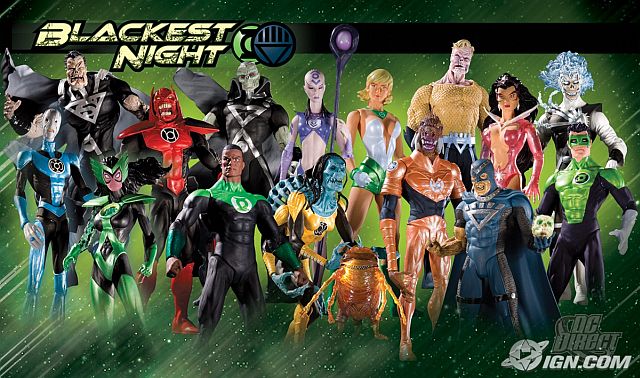
Two more omniscient narrators hammer the point home. The preview for Blackest Night: Batman #1 shows a page in which scenes only an omniscient narrator could be showing us include Black Hand staring lovingly at the skull he's toting and it has a bat-ear as a stylistic flourish. And more convincing yet, with the power of the almighty dollar behind it: The merchandising for Blackest Night includes a figurine of Black Hand wielding a skull with the same obvious Batman touches. (Remember that an action figure for Bart Allen as the Flash was revealed before it was revealed in the comics. And a poster showing Barry Allen as the Flash was released before his return to life.) Do you think anyone wants to refund fans' money if it turns out not to be Batman's skull? DC has hinted with innuendo that it's not Batman's skeleton, but has told us loudly with direct omniscient narration and action figures that it is.

Edit: Blackest Night: Batman #1 has Deadman say that it is Bruce's skull in Black Hand's grasp, and he seems to have that knowledge in some direct way that wouldn't be fooled by observing events in the conventional way (he didn't even know that Bruce had been replaced by Dick). Moreover, the bat-ears appear on the skull on the cover of Blackest Night #2.

Alpha and Omega

OK, so Batman's dead. Where is he?
Or "when"?

Despite what we saw on the last page of Final Crisis, scholarly fans are combing old stories trying to decipher what the Omega Sanction did to Bruce. But the simple answer is: No past story can be used as a guide, because the Omega Effect can do many different ("intriguing"!) things, depending upon Darkseid's whim, and he's often strangely generous. But sometimes not.

He has killed victims before, including Batman in an alternate timeline in Grant Morrison's "Rock of Ages" story in JLA v3. He also gave Desaad the "total wipe out" in New Gods #11 (a story by Jack Kirby -- Desaad's return six years later in a Gerry Conway story should be regarded a retcon).

But the first time we saw the Omega Effect (Forever People #6), it merely sent the victims into the past, and it was rather trivial for Highfather to retrieve the Forever People (leaving Sonny Sumo to live happily in Japan's past).

And Grant Morrison has concocted his own version of the Omega Sanction, showing Mister Miracle Shilo Norman living out a series of dreary lives that he had to live through in succession before he finally (naturally) escaped.

But what happened to Bruce needn't be any of those. And despite the suggestive presence of the rocket that had borne Batman's story to the past (as well as the bat-signal, if not other bat-relics), we know that the bearded man in Batman's pants, wearing the best boots the past had ever seen, is Batman, because Grant Morrison said "Final Crisis revealed Bruce is still out there and he’s got to make his way back in some way." So since it revealed that, that's him on the last page, not a Neanderthal enjoying someone else's pants.

If you can accept an old cop being possessed by an evil god who can shoot beams out of his eyes that can destroy a person or send the person alive into the past, then you can probably accept an old cop being possessed by an evil god who can shoot beams out of his eyes that can destroy a person and send the person alive into the past. Can't you?

Back in Time

A clever twist of Final Crisis is that one cover of the first issue showed the bat, super, and wonder symbols with a typical cave drawing of deer. This finished painting, which you see before the first page of the series, is not part of the narration anywhere until you get to the last page, when you see Batman beginning the painting.

Why did the Daily Planet's rocket land right where the Omega Sanction dropped off Bruce? Why did every last chunk of Krypton's explosion end up on Earth? Because it's convenient. That's usually a good enough reason.

Good news for our long-lost Batman. Cave Carson and his crew found, in Final Crisis #3, the symbol that Anthro painted in Final Crisis #7. If that's the same exact rendition, then Bruce's art is just a few feet away. His return to the present could be as simple as Cave Carson taking six more swings of a pickax, finding the heroes' symbols in the past, and then summoning some time-traveling JLAers to go get Bruce and bring him back. It could be that simple. Or arbitrarily complex.

But we do know that Bruce is coming back. The ghostly image seen in the previews for the third arc of Batman and Robin could be related or totally unrelated. (That image might not even be corporeal or even ectoplasmic in the "real" world of the DCU.) But as another post in this blog has mentioned, Grant Morrison has already told us plenty about Bruce Wayne returning to the Batman identity, and when. As for how -- I doubt if it will be as quick as the simple possibility mentioned above. Bruce Wayne's story is never that of someone who overcomes small challenges.